By eLotPay · Published and reviewed
Cross-border payment processing needs an operating plan that connects the customer’s purchase to the merchant’s usable cash. Accepting an overseas card is only one part. You also need to establish whether the business and product can serve that market, which currency the customer pays, how deductions are applied and where the proceeds arrive. Begin with one representative order in your next target market before extending the setup across your catalogue.
Map the countries before comparing providers
Write down the legal seller’s country, actual operating location, customer country, card issuer country, acquiring location and beneficiary bank country. These describe different parts of the arrangement. Ask the proposed provider which combinations it supports for your business activity. A supported currency does not establish that a business or customer market is eligible, and a successful test payment does not confirm approval for the whole catalogue.
The acquirer must identify the merchant correctly. The Visa Merchant Data Standards Manual describes validation of a genuine merchant location for card-absent businesses. Give the provider evidence of where the business actually operates, rather than choosing a location because it appears commercially convenient. If your question is about an overseas acquiring structure, read our separate offshore merchant account comparison.
Make three currency decisions explicit
Separate the currency of the customer’s payment method, the charge currency displayed at checkout and the currency used for merchant settlement. Stripe’s technical currency documentation illustrates this distinction and explains conversion when charge and settlement currencies differ. That is a technical reference, not a statement that its services or currency coverage apply to an eLotPay arrangement.
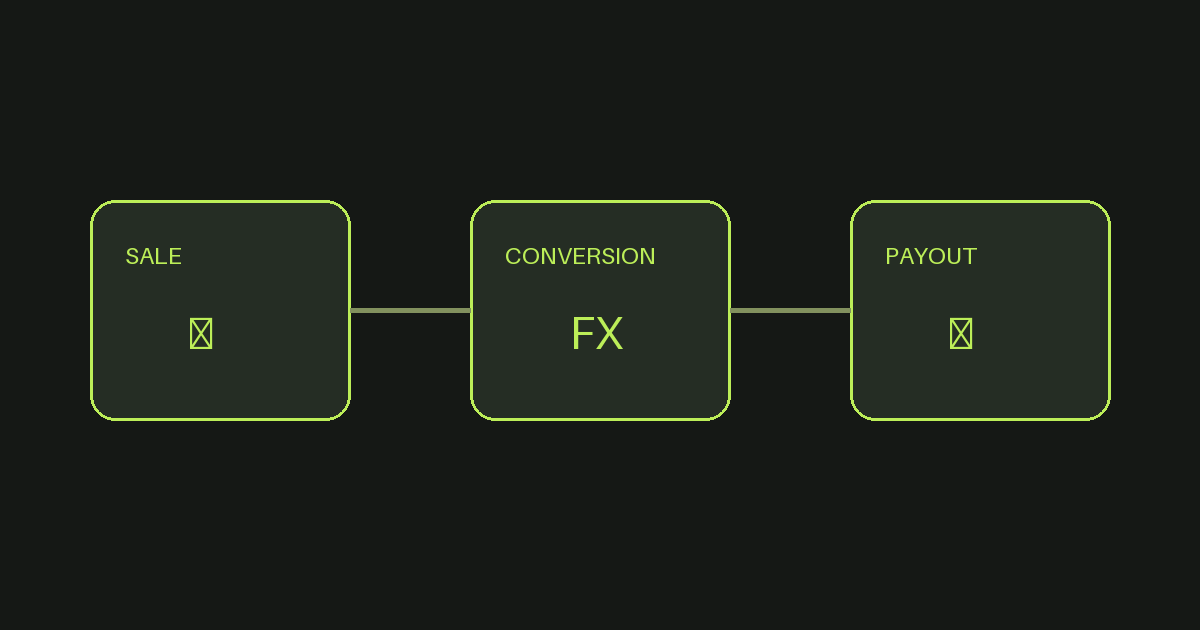
Ask for a currency matrix showing what can be displayed, charged, refunded and paid out for your entity. For each pair, identify who converts funds, when the rate is determined and which fees are additional. A euro price followed by a pound payout requires a different reconciliation from a euro price followed by a euro payout. Holding euros may suit euro expenses, but compare bank fees and conversion needs before assuming it reduces your overall cost.
Show the customer the transaction they will recognise
Carry the chosen currency consistently from the product page through the final payment confirmation and receipt. Make the final amount and currency clear before the customer pays, and explain delivery charges and recurring commitments where applicable. Do not treat a country inferred from an IP address as a reliable substitute for the customer’s currency choice.
Ordinary multicurrency pricing and dynamic currency conversion are different arrangements. Visa’s DCC explanation describes a choice involving a conversion rate and additional fees. If a proposed checkout offers that service, ask the provider how the choice and disclosures are implemented. Do not label a currency selector as DCC without understanding the actual transaction flow.
Reconcile a sale, then reverse it
Consider an illustrative software subscription charged at €100, with merchant payout in pounds. Ask the provider for a sample report that starts with that €100 capture and separately identifies processing deductions, any reserve allocation, conversion and the final pound amount. No fee or conversion rate is assumed here. Use the offered commercial terms to calculate the result, then compare it with the bank deposit rather than only the gateway balance.
Now refund the same subscription after the original payout. Ask which balance is debited, whether conversion occurs again and whether any original fees remain payable. If the merchant has no new sales that week, establish how the refund is funded. Finally, model a dispute after the refund request. Finance and support need a common payment reference so they can see whether a refund was completed before another reimbursement is considered.
Keep authorisation, capture, settlement and payout as separate statuses in the reconciliation. An authorisation is not cash available for payroll. A captured transaction may still be subject to settlement timing, deductions or exceptions. Our processing fees and settlement guide helps you list the commercial terms that affect usable funds.
Measure market performance without guessing
Review results by customer market, payment method, currency and recurring versus initial payment. Keep successful payments, declines, abandoned checkouts, refunds and disputes distinct. A single overall approval figure can hide a weak market or a changed customer mix. Compare like-for-like periods and note product or traffic changes before attributing an improvement to routing.
For a failed payment, use the provider’s documented response and permitted customer action. Do not turn every decline into an automatic retry on another route. Agree retry behaviour, duplicate prevention and the handling of uncertain outcomes before launch. If a payment times out, the customer experience should depend on the confirmed transaction state, not simply display a fresh payment button that could create a second charge.
Prepare a controlled market launch
Create a launch record containing approved entities, domains, products, markets and billing models; permitted currencies; beneficiary details; and escalation contacts. Ask who approves changes to those items. Have finance verify the first payout against the sample calculation, and have support test how it locates a payment, recognises the statement descriptor and follows a refund through completion.
Start with the agreed scope and review actual outcomes before expanding. For restricted or regulated activities, resolve the applicable permissions with qualified advisers and the underwriting team before accepting traffic. Neither foreign incorporation nor an international gateway removes the need to establish eligibility.
Frequently asked questions
Do overseas customers need to pay in my settlement currency?
Not necessarily. Presentment and settlement can differ where the arrangement supports it. Confirm the permitted pairs, conversion costs and refund treatment for your entity.
Will charging locally make a payment domestic?
Do not assume so. Ask the acquirer how the transaction is classified using the actual merchant and issuer locations. A local currency price does not establish local acquiring.
What should we send eLotPay for an assessment?
Share your legal entity, website, product scope, intended markets, billing model, expected activity and desired payout currencies. Our international payment processing service reviews acquiring, gateway and settlement requirements together. We support eligible merchants through that review; specific availability and terms remain subject to underwriting and the agreed arrangement.